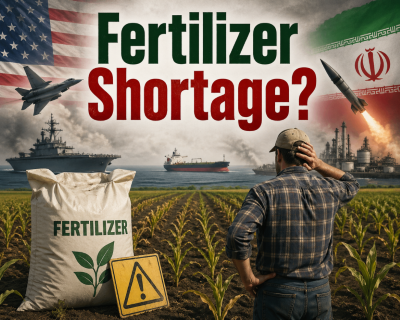
(Illustration above produced by ChatGPT for COGwriter)
After Russia began its Special Military Operation into Ukraine in 2022, there began to be shortages of fertilizer (see ‘Fertilizer Prices Continue Rising, Increasing Fears of Global Grain Costs and Shortages’). Then we saw a return of food price inflation (see Food Inflation: World Food Prices Jump Most In 18 Months).
One unintended consequence of the USA-Israel war against Iran has been a disruption of fertilizer exports which the Washington Post says is threatening the global food supply:
Iran war is crushing Asia’s farmers, threatening global food supply
Prices of fuel and fertilizer are pushing farmers to make irreversible cuts as they enter key planting seasons. …
The standoff between President Donald Trump and Iran that has brought shipping to a virtual halt in the Persian Gulf has set off supply chain shocks that are upending lives thousands of miles away in Asia, raising costs for farmers at the start of key planting seasons that will sharply reduce crop yields in the second half of the year and beyond, according to government officials, economists and farming groups. …
Dongyu Qu, the director general of the U.N. Food and Agriculture Organization, said the war had created not only a geopolitical crisis but “a disruption at the core of the global agrifood system.”
Iran’s destruction of gas infrastructure in the Gulf and the dueling U.S.-Iran efforts to choke the Strait of Hormuz have prevented crucial supplies of fuel and its derivatives like urea — a potent source of nitrogen that enhances harvests — from leaving the Middle East. Because fuel infrastructure takes years to build, there is no ready replacement for these supplies.
In effect, 30 percent of the world’s urea has been “wiped out,” said Pranshi Goyal, senior analyst at the market intelligence firm CRU Group. China, a major fertilizer producer, has restricted exports to ensure its farmers have enough. Russia, another big manufacturer, is seeing demand soar, potentially boosting its economy and aiding its war in Ukraine. On what is known as the spot market, urea prices are up 40 percent since February. …
As the war stretches deeper into the crop calendar, farmers from more countries will be forced to make similar choices, said Maximo Torero, chief economist for the FAO. “Right now, the impacts are more severe in Asia,” Torero said. “But clearly, this is moving east to west and south to north.”
In June, India and Brazil, two of the world’s biggest agricultural producers, will ramp up orders for urea. If, by then, vessels carrying urea are not sailing, there will be “significant yield loss” across many countries, Torero said. https://www.washingtonpost.com/world/2026/05/09/iran-farms-thailand-food/
It is not just Asia:
Fertilizer crisis: Africa …
For more than two months, there have hardly been any merchant ships passing through the Strait of Hormuz amid the ongoing blockade. Africa is being hit by the full brunt of the conflict in the Middle East, with canceled flights, long lines at petrol stations, and barren fields across the continent.
Left without access to a significant portion of their global supply chain, fertilizer industries have also been deeply affected by the crisis.
Any resumption of free maritime traffic through this strategically important strait — as was the case prior to the US-Israeli strikes on Iran earlier this year — is still a long way off; and even then, it would likely take months for markets to stabilize and for production lines and logistics to return to normal.
It’s understandable that African institutions and governments are currently operating in crisis mode, with no end to the blockade in sight. Some are even looking for ways to prevent more severe consequences, such as the risk of famine or national bankruptcies. …
“The situation is critical,” said Anja Berretta, director of the Africa Economic Program at the German Konrad Adenauer Foundation in Nairobi, Kenya.
“Especially when it comes to fertilizers, we were already facing a similar situation in 2022 when Russia launched its war of aggression against Ukraine; after all, Russia and Belarus were two of the most important fertilizer producers.” 05/08/26 https://www.dw.com/en/fertilizer-shortages-what-are-africas-options-during-the-hormuz-crisis/a-77094073
Fertilizer time bomb threatens to drive up Europe’s food prices
More than two months into the unfolding war in Iran, the conflict has yet to reach most shoppers at the checkout. Supermarket giant Carrefour insists its prices haven’t moved and German discount chain Aldi says the same.
It’s not going to last.
The war in the Gulf connects to higher prices on a baguette via three slow steps. Gas becomes fertilizer. Fertilizer feeds crops. Crops become food. Each takes weeks; the full cycle lasts months.
“Most of the food currently on supermarket shelves was produced using inputs that were purchased or contracted before the crisis fully unfolded,” said David Laborde, who runs the Agrifood Economics Division at the U.N’s Food and Agriculture Organization. “The current stability mainly reflects timing, not immunity.”
Europe produces its own nitrogen fertilizer, but makes it from imported gas. When Gulf disruption pushes gas prices up, European-made fertilizer gets more expensive too. 05/07/26 https://www.politico.eu/article/europe-farmer-fertilizer-prices-iran-war-inflation/
Food price inflation will increase.
Jesus said:
4 Take heed that no one deceives you. 5 For many will come in My name, saying, ‘I am the Christ,’ and will deceive many. 6 And you will hear of wars and rumors of wars. See that you are not troubled; for all these things must come to pass, but the end is not yet. 7 For nation will rise against nation, and kingdom against kingdom. And there will be famines, pestilences, and earthquakes in various places. 8 All these are the beginning of sorrows. (Matthew 24:4-8)
The rides of the four horsemen of the Apocalypse (Revelation 6:1-8) relate to what Jesus warned would happen.
And certainly we are in a time of wars and rumors of war.
Wars often lead to famines, food shortages, and/or food inflation.
Notice that this horseman results in scarcity and famine. Revelation 6:5-6 indicates that there will be food, but that it will be quite expensive (food-price inflation).
5 When He opened the third seal, I heard the third living creature say, “Come and see.” So I looked, and behold, a black horse, and he who sat on it had a pair of scales in his hand. 6 And I heard a voice in the midst of the four living creatures saying, “A quart of wheat for a denarius, and three quarts of barley for a denarius; and do not harm the oil and the wine.” (Revelation 6:5-6)
Consider also that food inflation is associated with the ride of the third horse, the black horse. And while that is commonly called the black horse of famine, the word famine is not in Revelation 6:5-6. That does NOT mean that there will not be any famines–for there will be–but food inflation will be considered as caused by government overprinting of money, crop matters, trade issues, etc. and most will NOT attribute it to the ride of the third horseman or the opening of the third seal.
But yes, some will thus die as they will not be able to afford it, while others will survive but struggle.
Related to food inflation, years ago, we put together the following video on our Bible News Prophecy YouTube channel:

12:03
Food Inflation & the 3rd Horseman of the Apocalypse
The Wall Street Journal, Reuters, UN’s FAO, and others are reporting food price inflation as well as often selected shortages of some food items. Might it get worse? Did Jesus prophesy famines? One analyst stated, “WE haven’t seen anything yet” in regards to rising food prices. Should Christians prepare? What about helping others? Does the ride of the third horseman of the Apocalypse (Revelation 6:5-6) point to a coming time of severe food inflation. Is more food price inflation coming? Dr. Thiel addresses these issues and more in this video.
Here is a link to the video: Food Inflation & the 3rd Horseman of the Apocalypse.
We are getting to the end of the 6,000 years that God has allowed humans to rule themselves, which will soon be followed by the 1,000 year reign of Christ. Pray for Jesus to return and God’s Kingdom to come (Matthew 6:10).
But prior to Jesus return,”there will be great tribulation” as Jesus foretold (Matthew 24:21).
Some articles of possibly related interest may include:
Four Horsemen of the Apocalypse What do each of the four horseman of the Apocalypse represent? Have they began their ride? Did Jesus discuss the any of this? Might their rides coincide with the “beginning of sorrows? Do they start their ride prior to the Great Tribulation? Did Nostradamus or any other ‘private prophets’ write predictions that may mislead people so that they may not understand the truth of one or more of the four horseman? There is also a related YouTube video titled Sorrows and the Four Horsemen of the Apocalypse.
Does God Have a 6,000 Year Plan? What Year Does the 6,000 Years End? Was a 6000 year time allowed for humans to rule followed by a literal thousand year reign of Christ on Earth taught by the early Christians? Does God have 7,000 year plan? What year may the six thousand years of human rule end? When will Jesus return? 2033 or 20xx?
When Will the Great Tribulation Begin? 2026, 2027, or 2028? Can the Great Tribulation begin today? What happens before the Great Tribulation in the “beginning of sorrows”? What happens in the Great Tribulation and the Day of the Lord? Is this the time of the Gentiles? When is the earliest that the Great Tribulation can begin? What is the Day of the Lord? Who are the 144,000? A short video is available titled: Countdown to the Great Tribulation.
LATEST AUDIO NEWS REPORTS