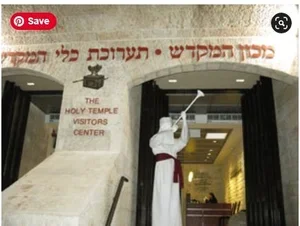
Temple Institute entrance
(Photo by Bob Thiel)
What should Christians focus on during these troubling times that Jesus referred to as "the beginning of sorrows"? The Jews of the Temple Institute sent out a newsletter on November 10, 2023 promoting the faith of Abraham. How was Abraham faithful? What did Abram do? Did he believe, obey, and do work? Did he, as the Apostle Paul later admonished Christians, to "walk by faith, and not by sight" (2 Corinthians 5:7)? Are Christians saved by faith for good works? Might Christians experience suffering? Can the example of the faith of Abraham be an example for Christians? Steve Dupuie and Dr. Thiel go over these matters.
A written article of related interest is available titled 'The Temple Institute points to the faith of Abraham in times of trouble’
A free online booklet is also available titled 'Faith for Those God has Called and Chosen‘
Originally published in November 2023.
TRANSCRIPT
Greetings, friends. This is Steve Dupuie for the Bible News Prophecy Program with Dr. Bob Thiel. Dr. Thiel, for the past several weeks we have been confronted with the possible misuse of artificial intelligence, droughts and food shortages, and wars and rumors of wars.
What should a Christian focus on in times like this?
According to Jesus, we should see first the kingdom of God and endure to the end. Now, one person who did type of endurance was Abraham. I got the newsletter from the Temple Institute out of Israel yesterday, and it had some things about Abraham, and I'd like to read over some of what they had.
They said, Abraham, our father, was a man of loving kindness. Wherever he went, he spread the light of God. He leapt up from a visit from God in order to invite three wayfarers into his home and give them a meal. He even argued with God like a man haggling in the market for the sake of the few righteous that were in Sodom. He did all he could for the betterment of his fellow man. He did all that God asked him.
God had promised him a son, and it took a long time. He waited. And at last, Abraham and Sarah had a son. And so God's promise of him becoming a great nation is off to the start.
But then, as it says in Genesis 22, two, it says, “Take your son, your only son who you love, Isaac, and go to the land of Moriah and bring him there for burnt offering on one of the mountains, which I'll tell you.”
So Abraham's future had seemed so bright, full of promise. Now, in an instant, they said it turned dark and full of despair. An entire life of devotion to God was in danger. The world that Abraham built with God was in peril of coming into ruin. Again, I'm reading from the Temple Institute.
But the faith of Abraham prevailed. Without flinching, he fulfilled God's every demand. And in the end, it all turned out well. An angel of God stayed or stopped Abraham's hand. Isaac was saved. Ram was sacrificed instead. Abraham passed his final test with flying colors.
Then Temple Institute continues with: Sometimes life grows bleak. A sudden cloud can cast darkness over all we've lived for and all we've accomplished and all we've hoped for the future. Abraham's test might be set before any of us in a moment out of the blue. Our accomplishments, our preparations for the future, are all at once irrelevant. The great test before us needs to be taken up head on. We are armed with but one essential asset to measure up to the challenge: our faith in God.
I would have to agree with that. Faith, especially in times like these, would be a major source of hope.
What else can the Bible tell us about the faith of Abraham?
Well, you go to the book of Genesis chapter 15, starting in verse 1. I'll read from the New King James Version of the Bible. Because after these things, the word of the Lord came to Abraham in a vision, saying, “Do not be afraid, Abraham. I am your shield, your exceeding great reward.” And Abraham said, “Lord God, what will you give me since I go childless and I have no offspring?”
Verse 4: And the word of the Lord came to him. One who'll be your offspring will come from your own body. He brought him outside and told him to count the stars, if you can number him. He said, “So shall your descendants be.” Verse 6: And he—that's Abraham—believed in the Lord and he counted it to him for righteousness.
And we read also in the New Testament in Romans 4, verse 3, it says: What does Scripture say? Abraham believed God and was accounted to him for righteousness.
That's a good point. That means our faith would also be accounted to us as righteousness.
What more can we learn from the faith of Abraham?
Abraham believed God when the circumstances looked impossible. And physically they were, because his wife was essentially too old to have children. But unlike a lot of people who profess Christianity, Abraham was willing to walk by faith, not by sight, which is what the Apostle Paul admonishes us in 2 Corinthians 5:7.
Now, in Genesis 26, verse 5, we find out that Abraham continued his belief through his actions. We read, “Abraham obeyed my voice, kept my charge, my commandments, my statutes, and my law.”
And in the New Testament, Hebrews chapter 11, verse 8, we read, “By faith Abraham obeyed when he was called to go out of the place which he could receive as an inheritance. And he went out not knowing where he was going. By faith he dwelt in a land of promise in a foreign country, dwelling in tents with Isaac and Jacob, the heirs with him of the same promise. For he waited for a city which has foundations, whose builder and maker is God.” Abraham believed, obeyed, and endured.
So our faith must be combined with obedience and endurance.
Does the Bible address those qualities, particularly as they might relate to present world events?
Yes. I'm going to go to Matthew chapter 24 and start with verse 3. Jesus was sitting on the Mount of Olives, and his disciples came to him privately and said, “Tell us, when will these things be, will be the sign of your coming and the end of the age?”
Jesus answered and said to them, “Take heed that no one deceives you. For many are gonna come in my name, saying, 'I'm the Christ,' and will deceive many. You're gonna hear wars and rumors of wars. See that you're not troubled. Walk by faith, not by sight. For all these things must come to pass, but the end is not yet. For nation will rise against nation and kingdom against kingdom. There'll be famines, pestilences, earthquakes in various places.”
Verse eight: “All these are the beginnings of sorrows. Then they're going to deliver you up to tribulation and kill you. You'll be hated by all nations for my name's sake. And then many will be offended, will betray one another and will hate one another. Then many false prophets will rise up and deceive many. Because lawlessness will abound, the love of many will grow cold.”
Why we'll have less Philadelphian Christians, because Philadelphia means love of the brethren.
Verse 13: “But he who endures to the end shall be saved. And this gospel of the kingdom will be preached in all the world as a witness to all the nations, and then the end will come.”
Jesus foretold the time we're now in, which he called the beginning of sorrows. 8: he calls it the time of troubles. He said, we need to endure through it, that the end will come after the gospel of the kingdom of God is preached enough through all the world. You need to have the faith to endure. And of course, you should be supporting the fulfillment of Jesus' commission in Matthew 24:14.
So, let me get this straight.
Are you saying that after 6,000 years of humanity, the prophecy foretold in Matthew 24:8 and Mark 13:8 is being fulfilled at this very moment, like right now?
Yes, because I believe we are in the beginning of sorrows. Now, related to faith, we actually wrote have a book available free online called Faith for Those God Is Called and Chosen. And I want to read a couple of things from this. For example, it starts off: I'm going to read what Paul said again, 2 Corinthians 5:7: “For we walk by faith, not by sight.”
Now, in practical terms, again, I'm reading from this, that means we live God's way of life even when we have trials and temptations, when things seem almost hopeless, or when others try to deceive us.
But Paul also wrote in Romans 3:31: “Do we then make the void the law of God through faith? Certainly not. On the contrary, we establish the law.”
And again, going through this, continuing this booklet, James chapter 2, starting in verse 17, James wrote, “Thus also faith by itself, if it doesn't have works, is dead. But some will say, ‘You have faith and I have works.’ Show me your faith without your works, and I'll show you my faith by my works. You believe that there's one God. You do well. Even the demons believe, and they tremble. But you wanna know, O foolish man, that faith without works is dead? Was not Abraham our father justified by works when he offered Isaac his son on the altar? You see that faith was working together with his works, and that by works faith was made perfect.”
Faith goes beyond just believing. Living faith includes action that God approves, living as Jesus did, and as he wanted his followers to do. Not only keeping the Sabbath or God's holy days when it seems difficult, but to tie the void pagan holidays like Christmas and be honest in a dishonest society, and also to love those who don't love you.
Abraham's faith was shown by obedience and works in how he lived his life, not in the manifestation of miracles from his prayers. Abraham had living faith. It takes faith to live God's ways in this world.
So, basically, there is no such thing as faith without works or obedience to the law of God. And yet obedience to God is manifested through faith.
Can the Bible explain this?
Well, Jesus laid out another specific goal. 48 says, “You should be perfect just as your Father in heaven is perfect.” So you have to believe and obey and do what you're supposed to do.
Now, we're not saved by works. Ephesians 2, starting verse 8, says, “For by grace you've been saved through faith, and that's not of yourself. Even the faith is the gift of God, not of works, lest anyone should boast.”
Now, some people like to stop there and they don't read the next part of the next verse: “For we are his workmanship created in Christ Jesus for good works, which God before prepared that we should walk in them.” So even though we're saved by grace, we're supposed to do good works. And we're supposed to be called and remain faithful. We don't just obey God. We need to have faith that His ways are best for us.
We're going to go to Romans chapter 8. Apostle Paul wrote, “For I consider that the sufferings”—starting in verse 18—“this present time are not worthy to be compared with the glory that will be revealed in us, for the earnest expectation of the creation eagerly awaits the revealing of sons of God.”
And going down to verse 28: “And we know that all things work together for good to those who love God and those who are called according to his purpose.” And when things go wrong or are unpleasant or difficult, it takes faith to endure to the end. It takes faith to realize that all things work together for good.
Now the Bible says a lot of the Old Testament was written for our example in 1 Corinthians chapter 10. And starting in verse 1, Paul writes about fathers who passed through the sea and baptized in their Moses. And the spiritual rock that followed them was Jesus.
Verse 5: “But with most of them, God was not pleased.” Verse 6: “And these became our examples.” We should not lust after the things they did. Nor let us commit sexual immorality, as many did, verse 8. Nor let us tempt Christ; some of them also tempted.
Verse 11: “All these things happened as examples, and they were written for our admonition, upon whom the ends of the ages have come,” which is where we are now. But he also puts in a warning. “Therefore, let him who thinks he stand take heed lest he fall.”
So all those in the Exodus drank from the same spiritual rock of Christ. Then they lusted after evil. I'm sorry, after evil. I don't quite get it yet.
Most in the New Testament, we're walking by sight and not faith. But as Christians, we have to have faith. In the New Testament, we're told about that as well.
So the point of the Scriptures is that even though they all drank from the same spiritual rock, they still did not have faith.
Tell us about the examples of faith highlighted in the New Testament.
Well, Hebrews chapter 11: we find out that faith is a substance for things hoped for, the evidence of things not seen. For by it, the elders obtained a good testimony.
And we find out: verse four talks about Abel offered God a more excellent sacrifice than Cain. By faith, Noah was warned of things not yet seen, but he did be supposed to do. Verse eight: by faith, Abraham obeyed when he was called to go out. Verse 17: by faith, Abraham, when he was tested, offered Isaac.
And the next chapter in Hebrews, after the faith chapter, this is actually chapter 12, it says, starting verse seven: “If you endure chastening, God deals with you as sons.”
And we're supposed to be chastened. It doesn't seem joyful, but it's painful. Nevertheless, afterward, it yields the peaceful fruit of righteousness by those who've been trained by it. Therefore, strengthen the hands which hang down and the feeble knees. Make straight to pass at your feet. So, what's lame will not be dislocated, but rather healed.
So, what the Bible is telling us then is that during this time of the beginning of sorrows, we are to obey God but to also expect chastening.
Yes, but it takes faith to do that. And more on faith can be found in our free booklet, Faith for Those God Has Called and Chosen.
Thank you, Dr. Thiel.
For more interviews with Dr. Thiel, in addition to written as well as audio articles, visit our website at biblenewsprophecy.net. This is Steve Dupuie for the Bible News Prophecy Program.
BIBLICAL PROPHECY INTERVIEWS