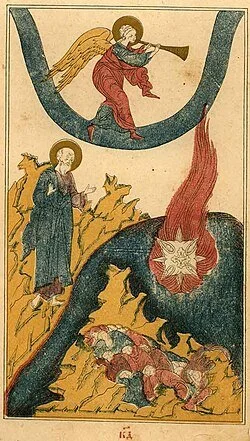

(Artist Depiction of Pentecost via Pixabay)
Does the Holy Spirit have a personal gender in the scriptures? Both ancient Hebrew (language of the Old Testament) and koine Greek (language of the New Testament) use grammatical gender when it comes to nouns. In the Hebrew scriptures, the terms for “Spirit” are ruwach or ruah--are they masculine, feminine, or neuter? What about the Greek term pneuma for "Spirit" in the New Testament? According to Protestant scholar Dr. Daniel Wallace are personal pronouns ever grammatically appropriate for the Holy Spirit? According to Eastern Orthodox priest Dr. Laurent Cleenwerck is it grammatically appropriate to use "who" or "whom" associated with the Holy Spirit? Do most translations of the New Testament intentionally violate rules of Greek grammar related to the Holy Spirit? Should people intentionally change the word of God to show a meaning that God did not inspire? Was the King James Version correct when referring to the Holy Spirit as 'it"? Does referring to a "she" as a "he" make it so? Dr. Thiel and Steve Dupuie go over these matters quoting scriptures as well as scholars who have translated the New Testament into the English language.
A written article of related interest is available titled ' What gender is the Holy Spirit?' URL: What gender is the Holy Spirit? - Church of God News
TRANSCRIPT
Greetings, friends. This is Steve Dupuie for the Bible News Prophecy Program with Dr. Bob Thiel. Dr. Thiel, the topic I would like to discuss today is the Holy Spirit. Specifically, is it male or female?
Well, actually, neither. But let's go to the Bible to find out what the Bible actually teaches.
First, let's start off in the second chapter of the Book of Acts. It talks about when the Day of Pentecost had fully come. The disciples were all in one place. There came a sound from heaven, and it filled the whole house where they were sitting. There appeared to them divided tongues as of fire, and one sat upon each of them. They were filled with the Holy Spirit and began to speak with other tongues as the Spirit gave them utterance.
Now, this was the formal beginning, if you will, of the New Testament Church. We see that God's Holy Spirit was given, and it was associated with something that looked like fire. Many languages, including Koine Greek, which is what the New Testament was written in, use what is called grammatical gender. The Koine Greek term for fire, by the way, is grammatically neuter.
Could you please explain more fully what you mean by grammatically neuter?
It means it is neither masculine nor feminine.
Now, while most translations of the New Testament into the English language use the pronoun "he" related to the Holy Spirit, as well as the relative pronoun "who," neither of those pronouns is actually supported by the Greek text. The Greek word for spirit is pneuma. It is a neuter gender. It is not masculine, nor should it be considered so.
Well, what about the Old Testament word for spirit? Is that masculine?
No. Actually, in the Hebrew Scriptures, the term for spirit used is one of two words, ruach or ruah, and they are feminine.
Yet despite this grammatical fact, some will look at mistranslations or point to commentaries. For example, here is an error from Matthew Henry's Commentary on the Whole Bible related to Genesis 1:1-2. It says:
"The plurality of persons in the Godhead. The plural name in Hebrew speaks of Him. The Spirit of God was the first mover. He moved upon the face of the waters."
You see "he" in this biased commentary. But that in no way supports the concept that the Holy Spirit is a male person. Because the term for spirit would be "she." Calling "she" "he" does not change the grammatical facts.
Well, if we don't use the word "he" when referring to the Holy Spirit, what word would we use that would be more grammatically correct?
"It."
Now, throughout the New Testament, translators often use "he" associated with the term spirit. But occasionally even the old King James Version got it correct and used the term "it."
For example, Romans 8:16 says:
"The Spirit itself bears witness with our spirit, that we are the children of God."
Verse 26 says:
"Likewise the Spirit also helps our infirmities. We know not what we should pray for as we ought, but the Spirit itself makes intercession for us with groanings which cannot be uttered."
"It" is the appropriate pronoun. The Holy Spirit is the power of God, and this was the belief of early Christians.
It took the Council of Constantinople, under imperial order from Emperor Theodosius, to make certain unscriptural declarations related to the Holy Spirit that many accept today.
Would one of those unscriptural declarations be related to the understanding of the Trinity?
Absolutely, yes.
I'd like to read something from Sean Finnegan. He had a paper titled The Holy Spirit in Translation Bias: A Smoking Gun of Trinity Mischief. Here is what he wrote:
"Although most Bibles stay relatively true to the original Hebrew, Aramaic, and Greek in most places, nearly all of them have significant blind spots that subtly lean towards Trinitarian theology. I want to expose one of these having to do with the Holy Spirit."
Seventeen out of nineteen translations he checked use the term "who" or "whom" referring to the Holy Spirit when, by the way, the Greek does not support that. This misleads honest-hearted men and women who simply want to understand what the Scriptures say.
He says, for example, the NASB translation team claimed to:
"Adhere to the literal philosophy of translation. It required a word-for-word translation that is accurate and precise."
Yet they did not properly translate the Greek word ho, which means "which."
The NET Bible boasts of having nearly 61,000 translator notes so readers can look over the translators' shoulders and make sure there is no bias. But he said they got it wrong as well.
He writes:
"Ironically, Daniel Wallace, one of the primary scholars involved in that translation, exposes this very issue."
Furthermore, he says:
"The NIV committee stated they were committed to the authority and infallibility of God's Word in written form, yet according to the infallible Scriptures their translation reads 'whom' instead of 'which.'"
This is a mistranslation. If the Scriptures are infallible, why is the NIV correcting them? And why do the other translations do it? Yet in various verses they do not translate it correctly. Why do all these translations think the simple word ho, which means "which," is really hon, which means "whom"?
That's amazing. This is truly a cover-up of biblical proportions. Is there any rebuttal against the charge of altering Holy Scripture by the translators?
Yes.
Actually, somebody told me that Dr. Daniel Wallace did try to get the neuter gender used for the Holy Spirit when he was involved in the NET translation project, but he was overridden. This is even more appalling when you realise that Dr. Wallace was actually the Senior New Testament Editor of the NET Bible.
Dr. Wallace himself wrote:
"About a dozen texts in the New Testament are used to support the Spirit's personality on the grounds of gender shift. That is to say, these passages seem to refer to the Spirit in a masculine gender in spite of the fact that the word pneuma is neuter, and grammatical concord would require any reference to be in the neuter gender."
Yet many theologians treat these passages as primary proof of the Spirit's personality.
He goes on to state that John 16:7 can be dismissed as proof. Whatever the reason for the masculine participle in that verse, the grammatisation of spirit personality is neither the only nor the most plausible explanation. Because the text involves serious exegetical problems, it cannot be marshalled as unambiguous proof of the Spirit's personality.
He concluded:
"In sum, none of the gender-shift passages clearly help establish the personality of the Holy Spirit."
Before going further, I looked at two translations of John 16:7 that do not make this error.
The CEV says:
"The Holy Spirit cannot come to you until I leave, but after I am gone, I will send the Spirit to you."
The AFV says essentially the same thing.
Now back to Dr. Wallace. He also wrote:
"There is no text in the New Testament that clearly or even probably affirms the personality of the Holy Spirit through the route of Greek grammar. Evangelical defences of various doctrines occasionally are poorly founded. We sometimes claim things to be true because we want them to be true without doing the exhaustive spade work needed to support the conclusions."
He continued:
"If grammar cannot be legitimately used to support the Spirit's personality, then perhaps we need to re-examine the rest of our basis for this theological commitment."
This was published back in 2003 in the Bulletin for Biblical Research. It used to be available online, but I found out this week they removed it. You cannot even find it online anymore.
Wallace wrote another paper where he explained that although some claim John 15:26 uses masculine language, it has nothing to do with the natural gender of the word pneuma, which is neuter. Yet this view remains especially popular among theologians and frequently becomes their main argument for the personality of the Holy Spirit.
Are there no theologians who understand the truth about these misinterpretations regarding the gender of the Holy Spirit?
Oh yes, there are many. But many also rely on false information to promote the Trinitarian personhood of the Holy Spirit.
That being said, there is an Eastern Orthodox priest and scholar whom I know by the name of Dr. Loren Klenewerck. He wrote:
"Greek manuscripts do not have any capitalization. Hence, the introduction of capitalised forms is arbitrary."
People see "Holy Spirit" capitalised and assume that means it is divine. No, translators simply capitalised it. That does not make it a person.
He also wrote:
"The first thing to notice is that both pneuma and ruach convey the meaning of breath or wind. That explains the subtle nuances in various biblical passages. On this basis, one can say that pneuma and ruach are used as references to an unseen causal agent whose effects are visible."
He continued:
"The Greek pneuma is neuter, which is why it is never spoken of with personal pronouns. An unbiased translation requires the use of the conjunctions 'that' or 'which' instead of 'who' or 'whom'."
Yet Dr. Klenewerck, who was the editor of the Eastern Orthodox Bible, had his Bible translate these verses using "who" and "whom" instead of "which," as they should be translated. They also use "he" and "him," which is likewise incorrect.
Some have also pointed to the use of the term "Comforter." That term is used in the Gospel of John and does have masculine grammatical gender. However, this noun is used to describe a function of the Holy Spirit, and Holy Spirit itself remains a neuter term. So while "Comforter" is grammatically masculine, it is not proof that the Holy Spirit is a man or a person.
Well, why not?
The grammatical reality is that the Greek noun pneuma, in all its various forms, is always and only neuter in gender. Likewise, all pronouns that refer to pneuma are always, and can only be, neuter in gender.
If the Holy Spirit were a masculine person, the nouns and pronouns in the Greek text would have been written in the masculine gender, just as those referring to the Father and to Jesus Christ the Son are.
Yet Dr. Wallace, Dr. Klenewerck, and others concluded that nowhere in the Greek text is the Holy Spirit designated by a noun or pronoun in the masculine gender.
Does the Bible give us a word of warning about those who knowingly twist the Holy Scriptures?
Yes.
False tradition often triumphs over truth. People should be able to read Bible translations and trust them, but they cannot always do that.
This is not new. Jesus complained that people preferred tradition over the Word of God in His day. He said to people who thought they were God's people in Matthew 15:7:
"Hypocrites! Well did Isaiah prophesy about you, saying: 'These people draw near to Me with their mouth, and honour Me with their lips, but their heart is far from Me. And in vain they worship Me, teaching as doctrines the commandments of men.'"
Real Christians do not hypocritically worship God in vain.
While Protestantism has tended to claim that it believes in sola scriptura, the Bible alone for doctrine, as opposed to accepting the councils of men as the Roman and Orthodox churches do, most Protestants have accepted traditions of men over the Bible related to the Holy Spirit.
Anyway, the grammatical gender of the Hebrew word for spirit is feminine, and the grammatical gender of the Greek word for spirit is neuter.
The grammatically proper conclusion after reviewing the Hebrew and Greek Scriptures is that the Holy Spirit is not a "he." If anyone wants to assign a gender to it, "it," meaning the neuter gender, would make the most sense for Christians.
Do not fall for false traditions that say the Holy Spirit is masculine based on scripturally improper translations of grammar, because that is false.
Thank you, Dr. Thiel. For more interviews with Dr. Thiel, in addition to written as well as audio articles, visit our website at BibleNewsProphecy.net. This is Steve Dupuie for the Bible News Prophecy Program.
This Bible News Prophecy Program was sponsored by the Continuing Church of God. For more information, including access to our free literature, visit BibleNewsProphecy.net or www.ccog.org.
BIBLICAL PROPHECY INTERVIEWS